Science & Innovation
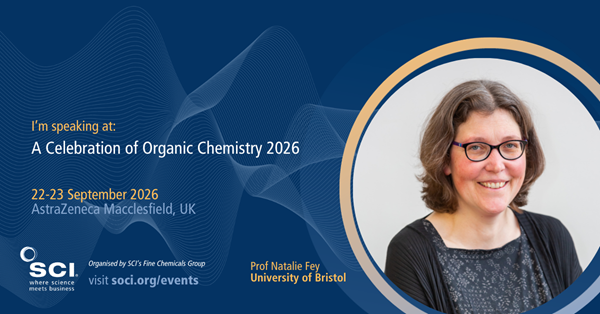
Ahead of the Celebration of Organic Chemistry event organised by SCI's Fine Chemicals Group, which takes place on 22nd and 23rd September at AstraZeneca's Macclesfield facility, organising committee chair Dr Christopher Jones asked some of the speakers about their careers so far and the current state-of-play in organic chemistry.
Natalie Fey is a Professor of Chemistry at the University of Bristol. Her group use computational approaches as a driver for scientific discovery, with a particular focus on organometallic catalysis. She completed her Ph.D. (2001) at Keele University, followed by postdoc positions with Rob Deeth (Warwick) and with Guy Orpen, Jeremy Harvey, and Guy Lloyd-Jones (Bristol). She was awarded an EPSRC Advanced Research Fellowship in 2007, appointed as lecturer in 2015, promoted to senior lecturer (2018), associate professor (2021), and professor in 2025. She is the programme director for Bristol’s programmes in Chemistry with Computing and an Associate Editor for Organometallics.
Here's what she had to say:
CJ: What do you think are the biggest challenges in your field and where do you see the most exciting advances being made in the next 20 years?
NF: I work in computational chemistry, using mechanistic calculations and data science approaches to inform and support synthesis, especially homogeneous organometallic catalysis. Our big challenge remains to put reliable prediction before synthesis, such that we can routinely recommend the best (or the best 5) catalysts to make a particular compound. Connecting synthesis and computation fully, with regular feedback loops for the validation of predictions, may sound a bit obvious, but it’s how we are going to achieve this.
CJ: What is the biggest change you have witnessed in the field of organic chemistry since starting your career?
NF: The routine use and integration of computational studies, and, more recently, the use of automation and HTE (High-Throughput Experimentation) to generate large datasets.
CJ: How do you see AI within organic chemistry?
NF: With a mixture of excitement and concern – when I started out, people were becoming very sceptical about DFT – a lot of people had had a go (perhaps badly) and been disappointed. I think we are about to fall off a hype curve with ML/AI in Chemistry. That doesn’t mean we can’t do good things with carefully trained and validated models, and there is some very good work taking place at the moment. But the initial rush has also produced some dodgy models and we’ll need to learn to distinguish between them, and to use the good things better.
CJ: Automated or manual column chromatography?
NF: Firstly, bleurgh, no! But actually, I used to like running a column so I could wander off and run my calculations (when I was still in the lab, I mostly made ferrocenes, which you could see coming off the column even from a distance). If an automation could just take that on, that’d be peachy… And if there’d been HTE, I might have lasted a bit longer in synthesis. In fact, I now have custody of an automated liquid handler (for teaching), which is great fun!
CJ: Which chemist do you most admire or has most influenced you?
NF: Some of the pioneers in applied computational chemistry (e.g. Jenny Green, Odile Eisenstein) made it look possible.
CJ: What would you prefer to do: a full day in the lab, or a full day writing a proposal?
NF: Running calculations is still my happy place!
CJ: What do you look for when hiring a new member for your team?
NF: Skills and the ability to articulate their views. Sometimes it’s a good thing if they can disagree with me (respectfully), too.
CJ: What would you be doing now if you weren’t a chemist?
NF: I would have liked to be an archaeologist, and I would probably have been the one making computer generated reconstructions of ancient sites. Or a palaeontologist, working out the bite force of a T-Rex from a computer model.
CJ: What one piece of advice would you have for a new PhD/postdoc/PI starting today?
NF: Nobody said it’d be easy…
Register for A Celebration of Organic Chemistry today at our early bird rate to hear Fey’s talk: ‘Guiding the selection of homogeneous catalysts with data’. She will be joined over the two days by a stellar lineup of other influential researchers, sharing the latest developments in organic chemistry.
Sign up here: https://soci.org/events/fine-chemicals-group/2026/a-celebration-of-organic-chemistry-2026
14 May 2026 |
|


 |
|

Science & Innovation
The Commonwealth Games has landed in Birmingham. Before the Games began, viewers were treated to an extraordinary opening ceremony (featuring a giant mechanical bull) and its artistic director, Iqbal Khan, was lauded for his ingenuity.
But such ingenuity shouldn’t surprise any of us, for Birmingham has long been a place of outsized invention. For more than 300 years, the inhabitants of this industrial powerhouse have churned out invention after invention; and its great pragmatists have turned patents into products.
Chemistry, too, owes a debt to the UK’s second city. Whether it’s the first synthesis of vitamin C, the invention of human-made plastic, adventures in mass spectrometry, or electroplated gold and silver trinkets, Birmingham has left a lasting legacy.
Here are five chemists whose innovations may have made an appearance in your life.
Alexander Parkes – man of plastic

Plaque commemorating Alexander Parkes in Birmingham, England. Image by Oosoom
Look around you. Look at the computer screen, the mouse button you click, and the wire casings everywhere. Someone started it all. That man was Alexander Parkes, inventor of the first human-made plastic.
The son of a brass lock manufacturer from Suffolk Street, Birmingham, Parkes created 66 patents in his lifetime including a process for electroplating delicate works of art. However, none were as influential as the 1856 patent for Parkesine – the world’s first thermoplastic.
Parkes’ celluloid was based on nitrocellulose that had been treated by different solvents. In 1866, he set up the Parkesine Company at Hackney Wick, London, but it floundered due to high cost and quality issues. The spoils of his genius would be enjoyed by the rest of us instead.
Sir Norman Haworth – the vitamin seer

Sir Norman Haworth
Sir Norman Haworth may have been born in Chorley, Lancashire, but his finest work arguably came after he became Director of the Department of Chemistry in the University of Birmingham in 1925. Haworth is famous for his groundbreaking carbohydrate investigations and for being the first to synthesise vitamin C.
By 1928, Haworth had confirmed the structures of maltose, cellobiose, lactose, and the glucoside ring structure of normal sugars, among other structures. Apparently, his method for determining the chain length in methylated polysaccharides also helped confirm the basic features of starch, cellulose, and glycogen molecules.
However, Haworth is most famous for determining the structure of vitamin C and for becoming the first to synthesise it in 1932. The synthesis of what he called ascorbic acid made the commercial production of vitamin C far cheaper – the benefits of which have been felt by millions of us.
For his achievements in carbohydrates and vitamin C, Haworth received the Nobel Prize for Chemistry in 1937 (shared with Paul Karrer). He was the first British organic chemist from the UK to receive this honour. Haworth even had a link to SCI, having been a pupil of William Henry Perkin Junior in the University of Manchester’s Chemistry Department.
Francis William Aston – adventures in mass spectrometry

Blue plaque for Francis William Aston. Image from Tony Hisgett
Another Nobel Prize-winning chemist from Birmingham is Francis William Aston. The Harborne native won the 1922 prize for discovering isotopes in many non-radioactive elements (using his mass spectrograph) and for enunciating the whole number rule.
For a time, academia almost lost Aston, as he spent three years working as a chemist for a brewery. Thankfully, he returned to academic life and obtained concrete evidence for the existence of two isotopes of the inert gas neon before the first World War.
After working for the Royal Aircraft Establishment during the Great War (1914-18), he resumed his studies. The invention of the mass spectrograph proved pivotal to his discoveries thereafter. Using this apparatus, he identified 212 naturally occurring isotopes.
George Elkington and John Wright – all that glitters

George Elkington patented the electroplating process developed by John Wright. Image from Spudgun67
It isn’t surprising that George Elkington should become an SCI favourite, as he blended both scientific ingenuity with business. The son of a spectacle manufacturer patented the first commercial electroplating process invented by Brummie surgeon John Wright in 1840.
Wright discovered that a solution of silver in potassium cyanide was useful for electroplating metals. Elkington and his cousin Henry purchased and patented Wright’s process before using it to improve gold and silver plating.
The Elkingtons opened an electroplating works in the city’s now famous Jewellery Quarter where they electroplated cutlery and jewellery. And they didn’t do too badly out of it. By 1880, the company employed 1,000 people in seven factories.
Alfred Bird – winging it

1906 advertisement for Birds Custard powder. Image from janwillemsen
In 1837, Alfred Bird was in a pickle. He wanted to serve his dinner party guests custard, but his wife was allergic to eggs and yeast, and egg was the main thickening agent of this delicious gloop.
Instead of serving something else, the chemist shop owner invented his own egg-free custard by substituting cornflour for eggs. His guests found it delicious and Bird’s Custard was born.
Not content with this innovation, Bird is also credited with being the father of modern baking powder. Once again, his wife’s allergies were said to be the inspiration, as he wanted to create a yeast-free bread for her. In bread and custard, true love always finds a way.
05 August 2022 |
|
|