
International teams of student entrepreneurs took to the stage at SCI’s Bright SCIdea challenge final, pitching their science-based business ideas to a panel of judges.
The Bright SCIdea competition – now in its eighth year - provides training and mentoring for aspiring entrepreneurs with science-based business ideas that could benefit society. The shortlisted teams get to present their ideas to a set of experts with a chance to win a top prize of £5,000.
Judging the competition this year were Victor Christou, managing partner at Hotdog Capital; Sarah Iveson, commercial unit head north-west Europe at Sygenta; and David Ring vice president – group innovation at Synthomer.
At the pitching competition final, held at SCI’s headquarters in central London, each team of students had five minutes to make their presentation to the judges and the audience, and then took questions and comments from the judges. SCI chief executive Sharon Todd opened the event with a welcome for the teams: “This is one of my favourite events because there’s always lots of passion, lots of interest and lots of great ideas – and it’s great to see future entrepreneurs pitching their ideas at SCI,” she said, encouraging the teams to take advantage of the opportunities for networking with the industry experts in the audience.
MediKeto
First to take to the stage was one of the international teams in the event. MediKeto, from the Institute of Science Tokyo, Japan, presented their idea for a digital app for sustainable ketogenic diet therapy in refractory epilepsy. While the ketogenic diet is used as an evidence-based treatment for drug-resistant epilepsy, the team said, it remains under-utilised because the daily management burden, something they hope the app could help tackle by improving adherence to the diet. The judges praised a ‘brilliant’ first pitch of the day and asked question around the plan for marketing the app and how the team would encourage its adoption. The judges also wanted to know the biggest challenge the team faced in getting their concept off the ground.
Ascenx
The second team to take to the stage were pitching an idea around materials and sustainability. Team Ascenx – with students from University College London – presented their concept for a subscription-based solution to enable safe disposal of arsenic waste while recovering the valuable material for resale - and creating clean drinking water. The judges said they enjoyed the ‘really interesting’ pitch and asked questions about how the team would protect their idea and stop others from doing the same thing. The judges also had questions around the business model in terms of whether the team would be able strike the right deals with waste providers and be able to sell on the recovered materials.
CheGo
The third pitch of the first session came from CheGo, a team of four from King’s College London. Their pitch was inspired by the experience of an intensive care unit nurse – also the mother of one of the team – and aimed to improve the patient experience of a commonly-performed yet vital medical procedure. Chego pitched an add-on sensor system that transforms standard closed suction catheters into precision-guided medical devices, providing real-time 'beeping' feedback to prevent over-insertion during mucus removal. The judges praised a “fascinating idea” and were interested to understand the additional costs and complexity the team’s sensor system would add, and the cost-benefit analysis of introducing the product. Judges were also interested in issues around regulatory approval and how Chego would validate the idea.
Napré
After a quick break, the first team in the second pitching session took to the stage. The team, with members from McGill University, Canada, Newcastle University, UK, Nnamdi Azikiwe University, Nigeria and Stellenbosch University, South Africa presented their business based around reimagining preservatives through the valorisation of agricultural bio-waste. The adverse impacts of preservatives in foods and other products are often neglected, the team said, and they pitched an idea based on a shift to safer preservatives while protecting the environment. The judges described this as a ‘cool idea and a lovely pitch’ and had questions around how the basic materials needed would be acquired, how the preservatives would be extracted from waste and the wider production process that the team’s idea would involve.
AvennaX
A team with members from Imperial College London, the University of Bath and the University of Southampton pitched next. AvennaX presented their idea for an automated computational platform that performs every step of protein structural analysis for every bioscience student and researcher - accelerating the discovery of life-saving medicines. The judges described their presentation as ‘tight and powerful’ and questioned why such a platform had never been built by anyone before. They also had questions about the how the team would evolve the business model for their service over time, and whether they had got any feedback thus far.
QROOT
The last team to pitch was QROOT. The team, from the University of Toronto and Brown University, US, took to the stage to present their automated ultra-precision farming system which remediates soil to optimal health, pre-emptively adapts to meteorological conditions, and shares actionable regional insights with the communities who need them the most. The judges praised an “interesting talk” and asked questions about the specifics of the technologies and discussed the potential options around the materials involved in the system. They also asked the QROOT team about the business model and pricing for different customers and any potential cost-benefit analysis the team had done for their system compared to other options.
While the judges made their decisions, the event also heard from Natasha Boulding, a Bright SCIdea winner from 2017, now the chief executive of Low Carbon Materials. Boulding spotted a flyer for Bright SCIdea on her lab desk one evening and decided to apply. “Bright SCIdea was really the first opportunity we had to even understand what a pitch was, understating what a financial forecast should look like,” she told the teams and audience.
Low Carbon Materials makes carbon negative materials for concreate and asphalt which can turn construction into a carbon sink, with recent projects including resurfacing part of the M11 motorway. “Being in a start-up and running a start-up is absolutely the most incredible journey but it’s a rollercoaster and you have to be resilient in so many different ways,” she said.
The prizes were awarded by Dr George Okafo, board trustee member of SCI. “Today I’ve been super-impressed by what I’ve heard – the energy the passion the enthusiasm the ideas the creativity has been really fantastic and in keeping with what SCI is trying to do. What struck me was the global reach and the global perspective,” he said.
Okafo began by revealing the winners of the poster competition which runs alongside the main pitching event. In third place was Healing Panels, in second place was Aquasurge and the winning poster team was Gene-erate.
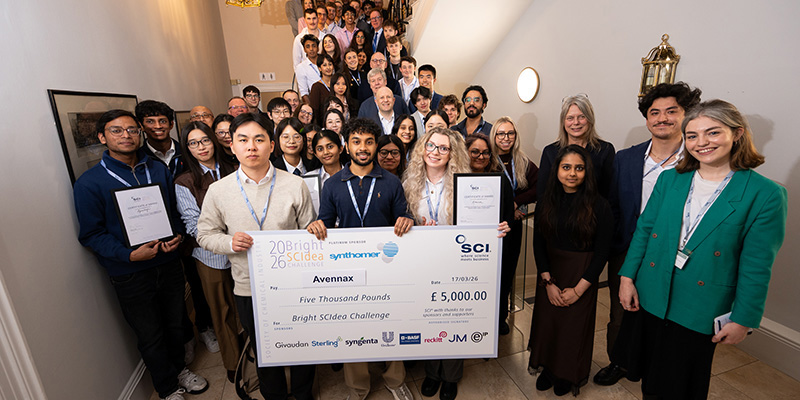
In the main pitching competition, third place went to MediKeto, second place to CheGo - and the overall winner was team AvennaX.
Tara Hudson-Ballard, from team AvennaX told C&I: “It’s amazing truly - it wasn’t something we necessarily expected coming into this, and it’s just so great to feel like other people can see the value in what we’re doing just as much as we can. We are looking forward to the next steps and what we can do with the funding.”
So what would she say to student entrepreneurs considering taking part in the next Bright SCIdea? “It doesn’t matter what stage your idea is at just apply. This is somewhere where scientific founders come when they only have an idea to gain the support the network and potentially the funding to build something,” she said.
“I think the most valuable thing for me has been coming today and meeting so many amazing other young scientists and hearing the ideas that they are trying to bring to market too,” she said.
Below - team AvennaX with their cheque and many members of the other Bright SCIdea teams at SCI headquarters.
Further reading
Student entrepreneurs announced as Bright SCIdea 2026 winners
Chemistry & Industry (C&I) magazine covers the people, the science and the industrial innovation being harnessed to tackle society's biggest challenges. C&I covers advances in agrifood, energy, health and wellbeing, materials, sustainability and environment, as well as science careers, policy and broader innovation issues. C&I’s readers are scientific researchers, business leaders, policy makers and entrepreneurs who harness science to spark innovation.
Get the latest science and innovation news every month with a subscription to Chemistry & Industry magazine. You can subscribe to C&I here.
 Visit Blog