
BY SHARON TODD | CEO
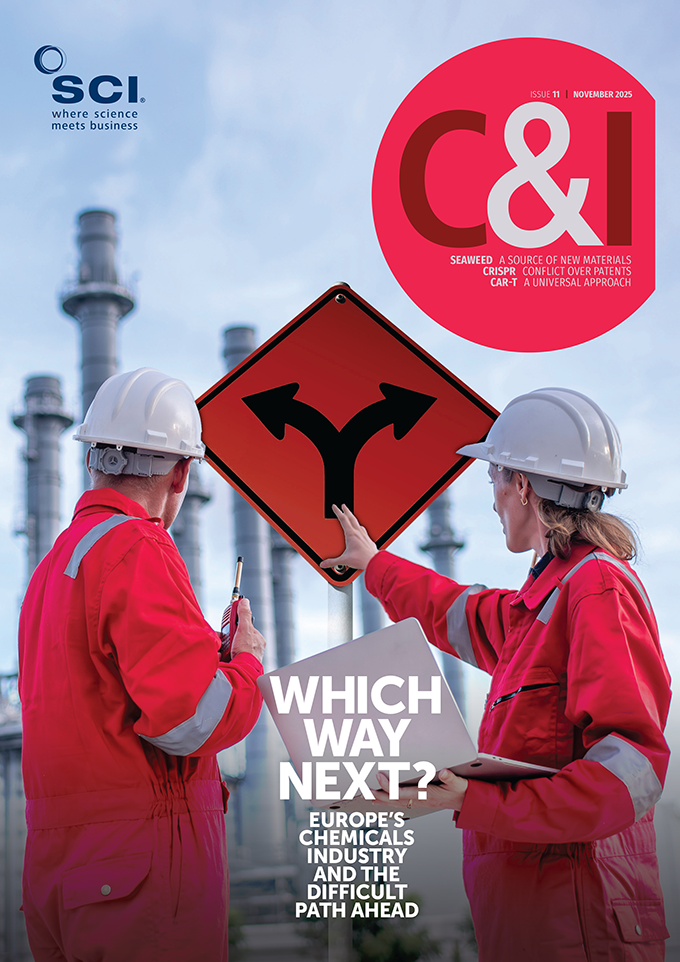
Europe’s chemicals industry has faced a number of severe shocks in recent years and is now at a tipping point.
It has been challenged by tough price competition due to the impact of shale gas in the US and the rise of the Chinese chemical industry over the last 10-15 years. EU demands to take fossil fuel out of the supply chain and the burden of regulation. Both REACH as well as environmental regulation, have added significant costs to business further reducing competitiveness. The war in Ukraine and subsequent repositioning away from Russian feedstocks has been the final straw – pushing some businesses to shut down and rationalise production.
A few data points can illustrate the scale of the issue. In September, Cefic released its trends report for the first half of 2025, which it described, in an understatement, as ‘disappointing’. In particular, it noted the competitiveness of the European chemical sectors remained well below the 2014-2019, or pre-Covid crisis, average – driven by weak demand and uncompetitive energy prices.
In the first half of 2025, European gas prices were three times more than in the US, putting European producers at a competitive disadvantage, the industry group noted. European capacity utilisation, at 74.6%, is another major concern as highlighted by Cefic, something that’s particularly an issue for commodity products and petrochemicals.
Plastics Europe, the association of European plastics manufacturers, has also noted how Europe’s global market share has collapsed from 22% in 2006 to 12% in 2024, despite a growing market. Elsewhere in this issue, a report from Boston Consulting Group shows how the chemicals industry is increasingly polarising, with hubs for commodity chemicals emerging and speciality chemicals an area of growth.
Further evidence of the challenge facing the industry can be seen in the trade figures. The EU chemicals trade surplus fell to €20.1bn in the first half of 2025, down 17% from the 2024 level.
Cefic’s members provide 1.2m jobs and account for approximately about 13% of world chemicals production. This proportion of the global chemicals production had previously meant that Europe was placed second, after the US, however, the rise of China has seen Europe slip into third place.
The critical nature of the situation has been highlighted by industry leaders. Sir Jim Ratcliffe, CEO of Ineos, has been particularly outspoken, warning that jobs are at risk over the next decade as a result of the potential collapse of the European chemical industry. As well as the direct industry job losses, Ratcliffe believes a further 10m jobs reliant on the chemicals sector for their employment could also be threatened).
All industry organisations, including Cefic and Plastics Europe, are looking for support. As Benny Mermans, President of Plastics Europe, emphasises: ‘Our region needs urgent political support and frameworks to reinvigorate investment and secure resilient and competitive supply chains. Europe must act now. Swift, decisive action is critical to secure the future of local plastics production and protect the strategic sectors relying on Europe’s plastics industry.’
Some have argued that Europe’s future is focusing on speciality chemicals; whilst others argue that delivering basic chemical products is vital to the economic foundations in the region.
And as we have seen in recent months and years, global supply chains can be surprisingly vulnerable; keeping industry close to home is now a key objective for many governments.
Listing the problems faced by the industry is one thing; finding a route out of the current situation is much harder. While there are no easy answers, governments need to understand two points: the strategic importance of the sector, and the importance of fossil fuel feedstocks into the future for the materials chains.
EU regulations and policies have overburdened businesses with costs and new policy frameworks are needed to ensure future competitiveness, whilst maintaining a focus on safety and sustainability. The EU is making noises to address these issues; however, long-term solutions are needed rather than short-term fixes.
 Visit Blog