BY JON EVANS
Plastics labelled as ‘home compostable’ all too frequently do not degrade as intended. Now, new research is digging deeper into our compost bins to find out why that might be. And the insights are shedding light on how to design better biodegradable plastics. Jon Evans reports
Home composting used to be simple. You took all your plant-based food waste to the bottom of the garden, dumped it into a bin or onto a big open pile, and occasionally added a bit of garden waste. Then you left it for several months or years, giving time for a plethora of microbes to consume the organic waste, producing a nutrient-rich compost to spread on the garden. But then came the development of biodegradable plastics and things became a lot more complicated.
Biodegradable plastics are designed to break down after use, unlike conventional plastics that can take hundreds of years to degrade and cause widespread pollution. Over the past few years, more plastic items have come on the market that are meant be thrown onto the compost after use. So far, most of these have been forms of packaging, from compost bags to food containers, all of which are expected to degrade away entirely when placed in a compost, just like food waste. But is that what really happens?
Compost confusion
A few years ago, researchers from the Plastic Waste Innovation Hub (PWIH) led by Danielle Purkiss at University College London, UK, tried to find out. In what they termed The Big Compost Experiment, the researchers recruited over 1600 people to monitor how biodegradable plastics in their home composts broke down over time (Front. Sustainability, 2022; DOI: 10.3389/frsus.2022.942724). What they discovered was that these biodegradable plastics often weren’t breaking down, or at least not fully.
In part, this was because people were getting confused about whether plastics labelled as compostable could go into home composts. Some biodegradable plastics, including polylactic acid (PLA), the most widely produced biodegradable plastic, can only be broken down in industrial composters, which operate on much larger scales than home composts and can thus achieve higher temperatures.
Products made from such biodegradable plastics need to state that they are ‘industrially compostable only’, but some people were clearly just seeing the word compostable and throwing them in their home composts. Purkiss and her team found that 14% of the plastic items placed in the home composts were industrially compostable only.
Even more concerning, they found that 60% of plastic items labelled as ‘home compostable’ didn’t break down fully in home composts. Rather than being entirely consumed by microbes, with carbon dioxide and water as the only byproducts, small plastic particles remained in the compost. These particles could then go on to contaminate the soil if the compost was spread on a garden.
But how could that be happening? Part of the problem is that there isn’t a clear consensus in the UK about what the terms compostable and biodegradable actually mean. ‘The marketing around these things isn’t very strongly regulated,’ Purkiss says. So, there’s not one standard accepted definition of ‘home compostable’.
Moreover, even if a product is fully broken down under simulated ‘home compost’ conditions in a laboratory, that doesn’t mean it will always break down in an actual home compost, where the conditions are hugely variable. ‘It’s very difficult to recreate home composting in the lab, because it’s a very varied and chaotic practice,’ says Purkiss. ‘It depends on where you are, how you want to compost, how often you turn your bin, how long you compost for.’
Biodegradable plastics can be made from natural materials, like lactic acid or starch, or from fossil fuels. However, they break down in exactly the same way as conventional plastics, which isn’t too surprising because both comprise long strings of monomers. The difference is that the chemical bonds holding together the monomers in biodegradable plastics are weaker and more cleavable than the bonds in conventional plastics. Such easily cleavable bonds tend to form between esters, amides and glycosides.
The first step in breaking down a biodegradable plastic involves cleaving the bonds between the monomers, converting the long polymer chains into lots of much shorter chains. These bonds can generally be cleaved by hydrolysis or oxidation reactions, via exposure to water and air for example, as happens in a compost.
Microbes in the compost, mainly bacteria and fungi, can also help the process along by releasing enzymes that promote the reactions. These microbes are then essential for the next step. Whereas microbes can’t consume long polymer chains, they can consume the much shorter chains generated after the bonds have been cleaved by hydrolysis and oxidation reactions.
But just like people have different tastes in food, different microbes prefer to consume different kinds of monomers and if your compost doesn’t contain certain types of microbes then it will struggle to break down specific biodegradable plastics. And the types of microbes found in different bins can vary enormously.
‘We did some testing of compost bins’ bacteria and enzyme profiles,’ explains Purkiss. ‘We looked at what was growing inside bins across the UK, and we found that every single bin’s bacterial profile was unique. We also found that the types of bacteria, and the enzymes they’re producing, had different abilities to break down those compostable materials.’ Some bins simply lack the microbes to break down certain biodegradable plastics.
The types of microbes colonising a compost depend on various factors, including its organic content, how moist and aerated the compost is, and what other microbes are already present. Temperature is also important, determining both the types of microbes and the compost’s efficiency at breaking down biodegradable plastics. Compost temperature depends on both the ambient air temperature and microbial activity, which generates heat as the microbes consume the organic material.
Up to a certain point, higher temperatures increase biodegradation efficiency. Higher temperatures promote hydrolysis reactions, enzyme activity and the metabolic activity of microbes. Polymer chains also become more flexible, making it easier for the microbial enzymes to access the chemical bonds. In temperate countries such as the UK, this means that composts are generally much more efficient at breaking down organic matter in the summer than in the winter.
If the temperature of the compost reaches 45°C, then it can start to be colonised by the thermophilic (heat-loving) bacteria required to break down biodegradable plastics like PLA. Such temperatures are generally only reached in industrial composters, whereas home composts, being much smaller, tend to lose too much heat to their surroundings. Although, due to the inherent variability of home composts, that is not always the case.
In their study, Purkiss and her colleagues found that a few home composts did reach temperatures of 45°C and so could break down PLA, but it required a lot of human involvement. ‘We found that some people’s bins were near or as hot as an industrial composter, because those people are like composting Jedis. They’re mixing, they’re oxygenating, they’re providing good surface area, they’re providing good ratios of nitrogen to carbon materials. So, they’re creating really good conditions for those thermophilic bacteria to take off.’
Purkiss doubts whether it’s possible to develop biodegradable plastics that will reliably break down in all home composts. ‘In terms of designing a material to consistently and predictably break down in a composting environment, that’s going to be nearly impossible if every single condition it’s going into is very, very different,’ she says. Nevertheless, that hasn’t stopped people from trying.
This includes some of Purkiss’ colleagues at the PWIH, who have been identifying the enzymes thermophilic bacteria use to break down biodegradable plastics like PLA. Leading on from that, other PWIH researchers are investigating the possibility of populating PLA materials with these enzymes during manufacture, so the enzymes are all ready to break down the materials when they’re dumped in a compost.
Pea protein
The PWIH also works with companies developing novel home compostable materials. These include UK company Xampla, which was set up to commercialise the research of Tuomas Knowles, professor of physical chemistry and biophysics at the University of Cambridge, UK.
In 2021, Knowles and his colleagues reported the creation of a novel flexible film made from pea protein (Nat. Commun, 2021, 12, 3529). They produced this film by dispersing pea proteins in a mixture of water and acetic acid and then lowering the temperature, which caused the pea proteins to self-assemble into a silk-like film. This advance stemmed from the group’s earlier studies into how silk proteins self-assemble.
Whereas the natural materials making up biodegradable plastics like PLA and thermoplastic starch have been chemically modified, that isn’t the case for this film. The proteins making up the film are just the same as in the original pea, meaning the film should break down in a home compost just like the peas it is derived from. And peas don’t tend to hang about in composts for too long.
‘On a chemical level, these materials are exactly the same as when they’re grown from the plant, and that means we can generate materials that provide performance but they do not have a lot of the issues that plastics have in terms of end-of-life,’ says Marc Rodriguez-Garcia, co-founder and chief technology officer of Xampla and a member of the team that developed the original process. ‘We’re taking these proteins from nature, we’re using them to provide some functionality and benefit and then they’ll end up going back to nature, so it’s a completely circular material.’ In tests, the film breaks down as fast as cellulose in soil, water and composts.
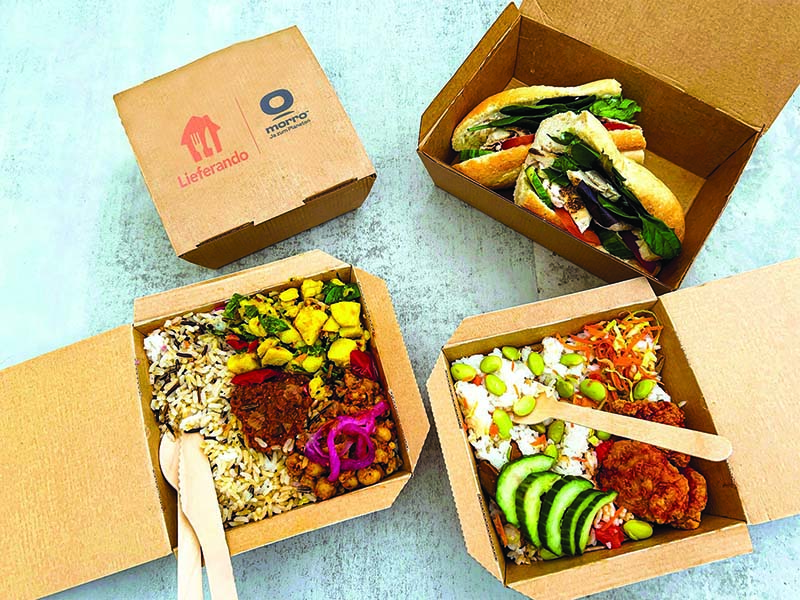
UK-based Xampla has developed Morro Coatings using plantbased polymers
Xampla has gone on to develop a large-scale production process for the film, which it markets as Morro for applications such as waterproof coatings for paper-based, compostable take-away boxes. ‘Fundamentally, the principles of the materials we developed and the processes are the same, but the implementation of that has changed quite a lot,’ explains Rodriguez-Garcia. ‘Specifically, we’ve had to adapt the type of equipment we’re using and some of the processing conditions.’
The company already has a pilot plant that can make hundreds of kilograms each day, which is where it conducts its process development. But its manufacturing partner, 2M Group of Companies, is now constructing a production site that will be able to produce 1000t/year of Morro.
Xampla still uses pea proteins to produce its Morro films, as well as corn proteins, but it is investigating using cheap agricultural byproducts such as rapeseed meal, left-over after the oil has been extracted, as a protein source. It is also looking at ways to apply its protein technology to a broader range of applications, perhaps by combining it with other biodegradable technologies.
‘We want to continue developing the next generation of materials that are going to expand our portfolio, so we can end up with different products that can solve specific problems in the industry, again with a completely natural polymer solution,’ says Rodriguez-Garcia. ‘It is a technically challenging problem that we are happy to try to solve.’
If they do, perhaps home composting can once again become a simple activity.
 Visit Blog