
BY MAX CROWLAND
A short video clip posted on social media by Tesla in January 2026 served as a perhaps modest introduction of a major development: the electric vehicle maker’s new lithium refinery – the largest in North America – becoming operational.
The plant in Corpus Christi, Texas will take spodumene – a material rich in lithium – and process that into battery-grade lithium hydroxide.
Complete with a cameo for Tesla’s Cybertruck, the video gave a quick tour of the state-of-the-art refinery process in action. That Tesla has decided to build its own refinery, and invested $1bn in the plant, along with the rapid pace in setting it up (three years from ground first being broken to refined lithium hydroxide being produced) all reflects how important the supply of critical materials, and the creation of reliable supply chains to deliver them, has become.
Tesla’s project is not the only big lithium project underway in the US: Lithium Americas is developing the Thacker Pass project located in Humboldt County in northern Nevada, which hosts the largest known measured lithium resource and reserve in the world.
Access to critical minerals such as lithium will define future growth for many businesses and economies. As the key component in batteries and fuel cells, lithium is central to everything from electric vehicle manufacture to renewable energy grids. Demand for lithium is likely to continue to grow, which means that the economies that are able to secure a reliable supply of the mineral (and more specifically battery-grade refined lithium carbonates and hydroxides) will be in a strong position for industrial growth well into the future.
Inevitably, how global supply chains have developed has depended on where lithium is found and processed, and used.
Currently lithium is mined in large quantities primarily in Australia, South America and China.
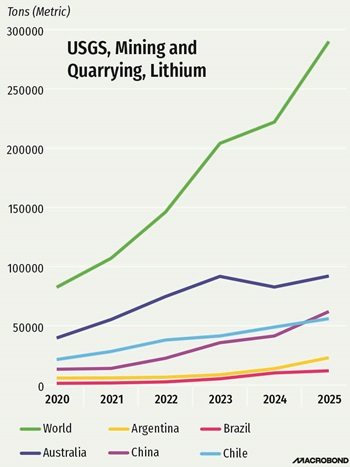
According to analyst Wood Mackenzie, by 2027, China is forecast to host 32% of global lithium production domestically, with overseas projects controlled by Chinese companies accounting for a further 18%. That means Chinese entities will likely control 50% of the total market, up from about 35% just five years ago, it notes.
Other major economies do have their own significant lithium reserves (for example, companies are working on lithium projects in areas such as Cornwall, UK). But wherever it comes from, the lithium needs to be refined into lithium carbonate or lithium hydroxide for use in batteries and cells.
Approximately 67% of global lithium supply is processed by China. The largest extractor of raw lithium, Australia, exports 96% of its lithium output to China for refining. Wood Mackenzie calculates that Chinese domestic plants will also account for 81% of global spodumene refinery production by 2027.
China’s central position in the lithium supply chain – alongside its moves late in 2025 to increase export controls around rare earths and some lithium battery technologies – has worried some countries and highlighted the complicated state of current global supply chains.
China’s own production of lithium is, for example, not the only reason for its strong position in the supply chain. China also sits at the centre of the supply chain for lithium because it is by far the world’s biggest producer of EVs, which account for 70% of lithium battery use.
The International Energy Agency (IEA) shows that investment in green energy, of which EV manufacture is one of the key drivers, has grown by $288bn in China, compared with a $110bn increase in the US and $184bn rise in the EU.
The US scrapped some tax credits on EVs as of late 2025, while many EU states have reduced or removed subsidies as well, even as China has extended its trade-in incentive programme. One consequence of policy changes like this is that they risk increasing hurdles to investment in the US and EU even as further investment is being encouraged in China.
Data from the IEA shows worldwide sales of electric cars increasing from 1.2m in 2017 to 17.5m in 2024, and forecasts that number to grow to 40m by 2030 – with China accounting for over 50% of this growth. If the bulk of lithium demand is coming from China, then it is perhaps no surprise the bulk of lithium mined and refined will continue to be from China.
Lithium is just one example of a critical material with a complicated supply chain. And as a result, critical minerals and the need for resilience are climbing the agenda for many governments.
The US, EU and Japan have recently signed an agreement to ‘identify and support projects in mining, refining, processing and recycling’, and the UK has announced its Critical Minerals Strategy to ensure national resilience and support its new industrial strategy.
As mentioned, these countries do have lithium reserves available to them, so there is the potential for developments around extraction and refining.
If states have the capacity to cost-effectively refine raw lithium, then reliance on importing from China will likley decline. Countries will be able to refine their own stores, but also import lithium where better trade relationships exist. This would reduce the impact of any potential supply disruptions.
These however are time-consuming and costly projects industrial projects to get right and in most cases countries will be attempting to catch up with mature industry in China.
As more and more batteries and cells are consumed, recycled lithium becomes a viable and abundant source of supply. There will be first mover advantage for the organisations and economies that can efficiently reuse these cells, with the current percentage of lithium in the supply chain coming from recycled sources being negligible.
In countries that are keen to build out their own lithium supply chain, government support is likely to be needed – this, as Wood Mackenzie states, is because mid-stream processing often fails to generate substantial profits and will certainly be more expensive than existing operations because of higher labour equipment and environmental costs.
A report in 2025 from the Kleinman Center for Energy Policy on Li-ion policy and supply chain dynamics in the US and China states it would serve the US to support domestic efforts around creating robust mineral supply chains in the form of mining, processing, and manufacturing. ‘Policies like tariffs and export controls need to be combined with investment in the domestic industry,’ it said.
‘That includes investing in research, workforce development, and infrastructure. Otherwise, these policies will just make lithium-ion battery manufacturing more expensive and stifle production efforts.’
This means continuing to attract and support investment new projects to find and process lithium. Projects could be seen as essential to supply chain and energy security, especially as the impact of protectionist policies, including US import tariffs and Chinese export controls becomes increasingly unclear.
Already some shifts in the global supply chains are underway – according to the IEA, the US and Europe are leading the expansion of battery production capacity, each accounting for around 40% of capacity outside China by 2030.
The IEA also notes the US has several midstream projects under development, notably in lithium iron phosphate cathode and anode materials, which could help mitigate two of the major vulnerabilities in its supply chain, ‘though these remain insufficient to offset reliance on Chinese supplies’.
The EU, Japan and US strategic partnership signals the urgency with which critical minerals resilience is now being treated among the major economies. The partnership sets out its aims of securing a stable supply of critical minerals through exploring new sources and refinery and recycling projects.
However, what it is less clear about is how countries aim to tackle issues of stimulating demand and attracting investment at the final stage of the supply chain in the form of EV manufacturing plants and other industrial infrastructure.
Without this, nations will still be relying on international trade to export refined lithium and import finished products.
Investment projects such as the Tesla plant in North America have strong focuses on using new, more efficient, and cleaner methods of refining lithium, and indicate a strong and urgent response to concerns abou the international supply chain.
This speaks to where the advantages in the lithium race are to be found, through innovation. They also have the automotive investment at the end of the supply chain to be fully resilient to external shocks.
But there is a further potential complication. New battery chemistries and technologies, and methods of extracting, refining and recycling are being continuously developed meaning supply chains, mines and manufacturing plants not only need to be established, but also have built in agility and potential to adapt.
That means being ready not just for the complicated technology supply chain of today, but also the one that is likely to appear tomorrow.
 Visit Blog