
Harry Palmer was awarded a Messel Travel Bursary to attend the 5th Alpine Winter Conference on Synthetic and Medicinal Chemistry in St Anton, Austria. Here he tells us about his highlights from the conference.
"Earlier this year, I delivered a poster presentation while attending the 5th Alpine Winter Conference on Synthetic and Medicinal Chemistry in St Anton, Austria. This week-long biennial conference, sponsored by the European Federation for Medicinal Chemistry, brought together industrial and academic chemists and biologists at a range of career stages from around the globe.
"Over the course of the week, lectures were delivered on topics ranging from the role of AI in accelerating drug discovery, modern advances and transformative strategies in organic synthesis, and drug discovery tales from industry programmes. As an early career researcher, these sessions delivered invaluable insights into modern medicinal chemistry. The sessions explored the strategies and techniques currently employed in the drug discovery process to improve pharmacokinetic profiles, such as clearance and solubility. It was also discussed how we can adapt the existing principles of small molecule design to accommodate novel molecule classes such as heterobifunctional degraders (PROTACs) and peptide therapeutics, which both featured heavily in the talks and are clear areas of growth in industry and academia. Looking to the future of drug design, the session on speeding up drug discovery explored the role of AI in drug discovery, and it was particularly insightful to understand how large language models and machine learning are being employed to both discover bioactive molecules and identify chemical strategies to synthesise them.
"One session in particular which interested me was “Recent Advancements in Radioligand Therapy (RLT)” for targeted cancer treatment. RLTs aim to selectively deliver radionuclides into tumours, through binding to surface-exposed proteins on the tumour. This modality functions similarly to antibody-drug conjugates (ADCs), a field I have explored through my own PhD research, and it was exciting to learn about the similarities and differences between the two fields, in particular where RLTs are able to offer complementary pharmacology to ADCs. While seeking to achieve the same goal of targeted tumour delivery, RLTs often have short serum half-lives (~12 hours), aiming for “fast in-fast out” pharmacology: this strategy aims to rapidly deliver radionuclides to the tumour cells, while excess RLT is cleared from the serum quickly to reduce toxicity, typically to kidneys. This in contrast to ADC pharmacology, which typically aims for long serum half-lives (~21 days) to allow continuous exposure of the ADC to the tumour.
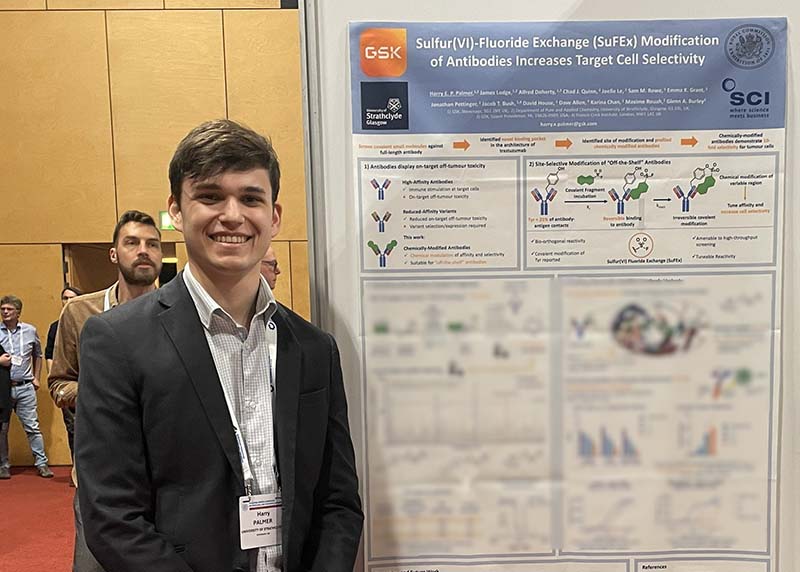
"My own research on antibodies, ADCs and selectivity was closely related to this session on RLTs. During the poster presentation sessions, I had many insightful discussions with the session’s speakers and other delegates on the importance of antibody therapeutics in cancer treatment, as well as challenges to be overcome in the field. I discussed with experts in cancer therapy and chemical biology the significance of my research, which enables the selectivity profile of antibodies to be improved through chemical modification of the antibody, thereby reducing the off-tumour toxicity of antibody therapeutics. The productive conversations I had with the delegates gave me exciting insights into future directions for my research, which I look forward to working on in the final year of my PhD.
"Furthermore, I was delighted that my poster presentation entitled “Sulfur(VI)-Fluoride Exchange (SuFEx) Modification of Antibodies Increases Target Cell Selectivity” was awarded one of three best poster prizes at the conference, as voted for by the delegates out of a total 72 posters on display. It was highly rewarding for my research to be endorsed by the conference attendees, demonstrating its applicability to modern drug discovery, and I hope to incorporate the knowledge gained through attending this conference into my future research on antibodies and targeted drug delivery in the final year of my PhD.
"I am very grateful to the SCI for supporting my attendance at this conference with a Messel Travel Bursary. Meeting scientists from around the globe has provided with new insights into the fields of synthetic and medicinal chemistry, and I have no doubt that the wide range of lectures I have attended during the week will prove invaluable as I continue to build my career in medicinal chemistry and drug discovery."
Harry Palmer
PhD student
University of Strathclyde
 Visit Blog